Why Red Matter’s Grabber Tools Feel Part of the World
This design reading considers the controller-matched grabber tools of Red Matter 2, asking what interfaces gain when they belong to a scene.
Red Matter 2 offers a revealing case study in how VR controls can be made visible within a fictional world. A Road to VR design analysis focuses on the game’s grabber tools. It says their controller-matched form aligns physical input with virtual posture. It also frames button references and terminal connections as interactions that remain inside the game world. The value of the example is not a universal prescription. It is a prompt to ask whether an interface explains the hardware while still belonging to the scene.
A tool instead of an abstract hand
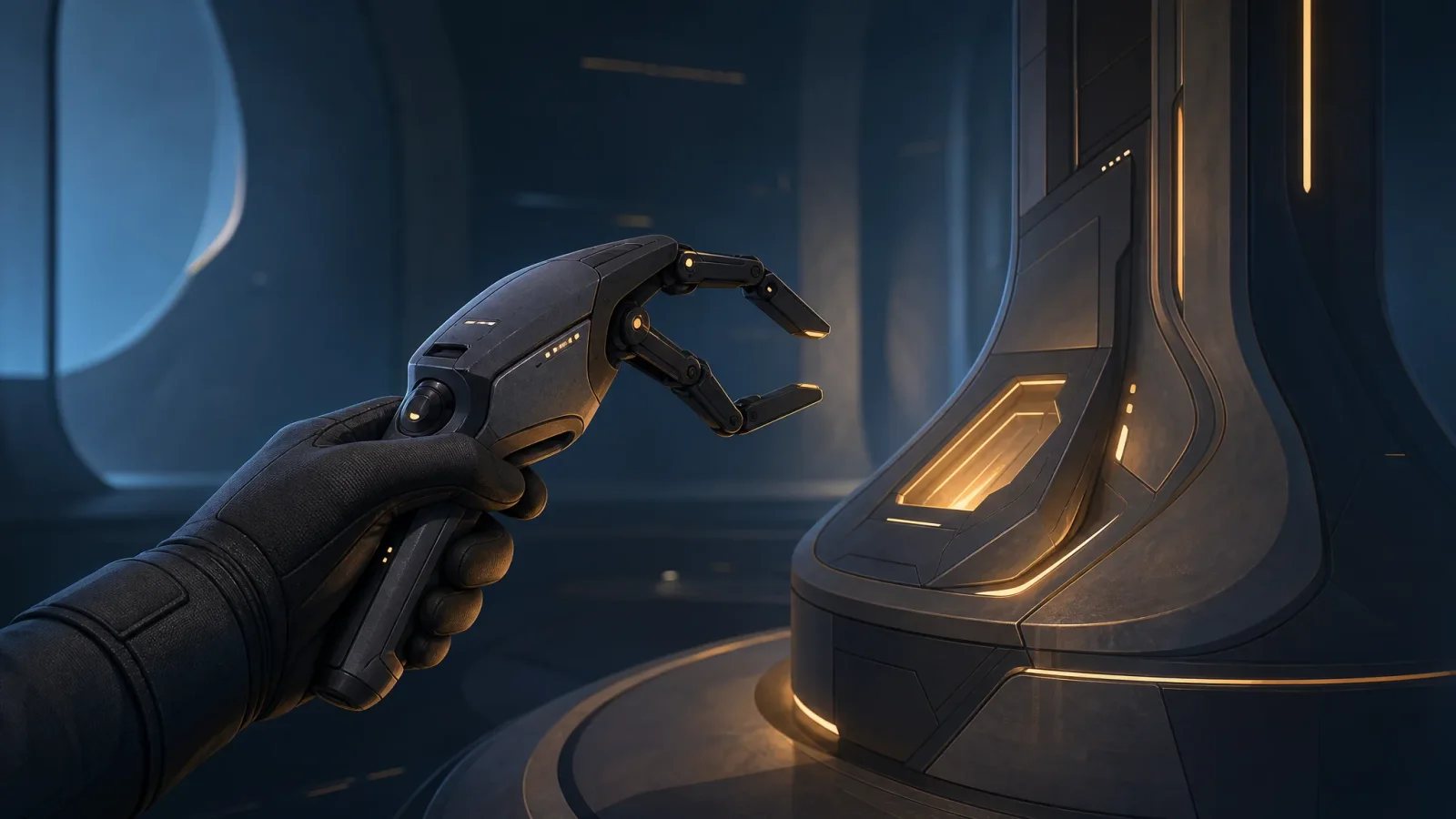
According to the analysis, Red Matter 2 changes the grabber tool’s form for Quest, Index, and PSVR 2 controllers. That choice makes the object in view resemble the object held by the player. The analysis argues that this correspondence brings the visible hand pose closer to the player’s physical grip. It treats that visual and physical alignment as one contributor to immersion rather than as a guarantee of it.
The distinction matters because a virtual hand can imply more dexterity than ordinary controller input supplies. Road to VR’s reading is that a tool with one grabbing point makes that constraint legible. Instead of presenting fingers that appear ready for fine manipulation, the tool establishes a more limited interaction model. In this framing, limitation becomes part of the fiction rather than a discrepancy the player must ignore.
Putting control hints in the world
The analysis calls the grabber tools a diegetic interface because players can inspect them for button references. It also describes the tools as physical connectors for terminals. These details move two familiar tasks—remembering controls and initiating an interaction—away from detached prompts and toward objects in the scene.
That approach does not mean every interface should disappear. It does suggest a useful test for designers: when a prompt is necessary, can its purpose be expressed through something the player could plausibly encounter? A tool, panel, or terminal can carry instruction and atmosphere together when its function is clear.
Why the off-topic hook should stay separate
The PlayStation Blog item in the research pack is a community-sharing roundup that asks readers to post tree imagery with designated hashtags. It is not evidence of a VR release, product feature, or development change. Keeping it separate from this analysis avoids turning an unrelated community prompt into a news justification.
The stronger editorial subject is the design interpretation itself. Road to VR examines the grabber tools as a choice intended to support immersion and interactivity. That is a narrower claim than declaring the feature effective for every player, but it is also the more useful one. It invites attention to the relationship between what a player holds, sees, and is asked to do.
Why it matters for VR design
For players, the example offers a way to notice interface design that may otherwise fade into the background. For designers, it highlights the potential value of representing input honestly. A controller-shaped object can give limited input a role that makes sense in the fiction, according to the analysis. It can also make buttons and interaction targets referenceable without automatically sending the player to a separate menu.
The practical lesson is to examine each break between input and world. If a control hint, interaction cue, or hand representation feels detached, an in-world object may offer a more coherent alternative. The goal is not to eliminate UI as a rule. The goal is to make necessary guidance feel situated, understandable, and appropriate to the task.
Conclusion
Red Matter 2’s grabber tools are interesting because they combine controller representation, button reference, and terminal interaction in one visible object. The supplied analysis presents that combination as an immersion-minded design choice. Its lasting value is less about copying a sci-fi prop than about designing interfaces that acknowledge the input players actually have.